The Free AI Music Platform Nobody's Talking About

Over the past few days, I ran a structured 3×3 test on Treblo, the free AI music generation platform (formerly Sonauto). No sponsorship, no affiliate link — just a creative director's curiosity and a spreadsheet mindset applied to song generation.
I tested three genres — English Pop, Indonesian Dangdut, and Pop Orchestra — across three creative modes: auto-generated lyrics, custom lyrics I wrote myself, and instrumental-only. Twelve tracks later, here's what I actually found.
What Is Treblo?
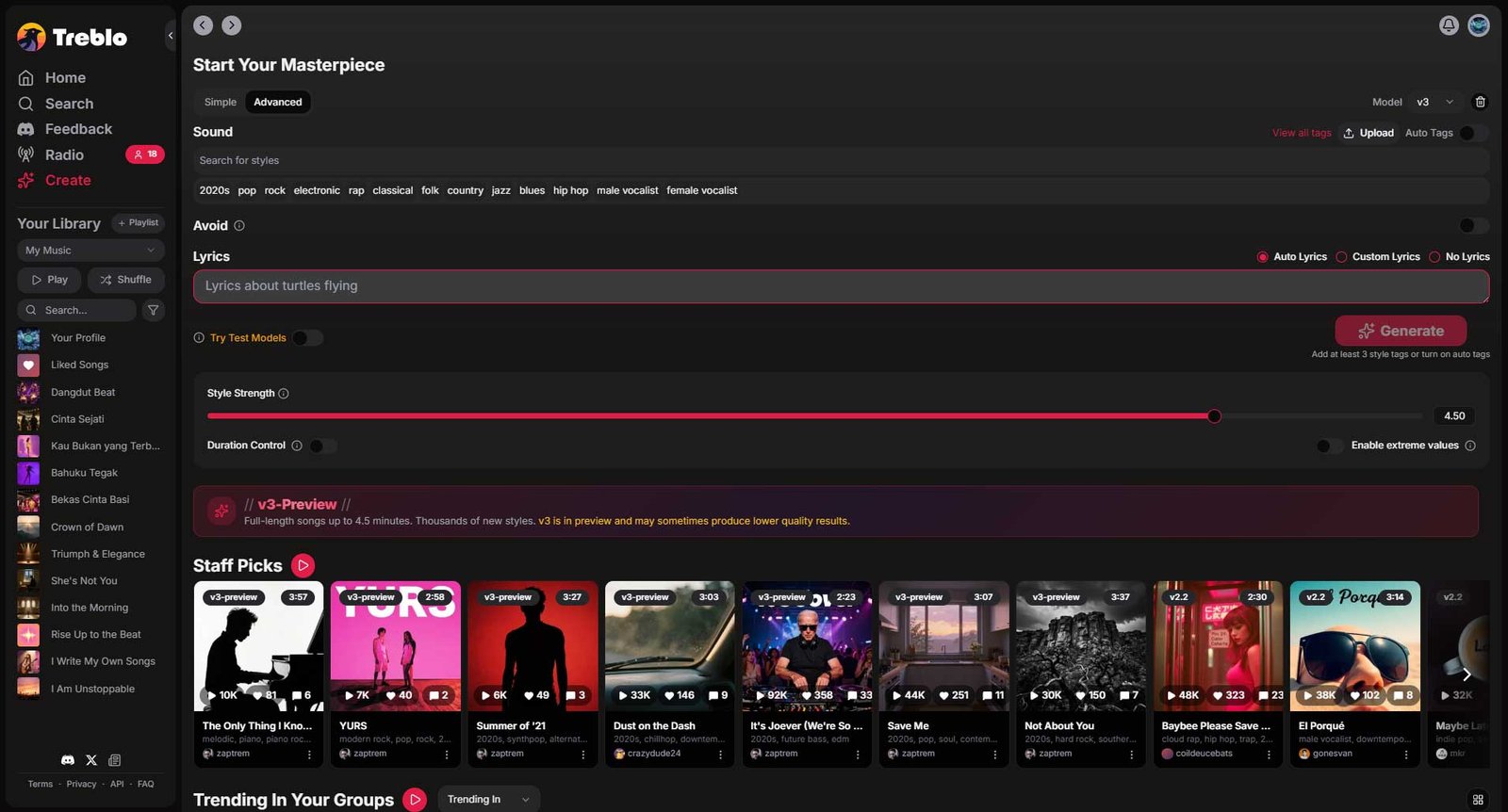
Treblo is a free AI music generator built on a model called Melodia, now in its third generation (v3-preview). It turns a text description into a complete song — vocals, lyrics, instrumentation, structure — in about 15 seconds for the first audio, with the rest streaming in as it renders.
It was rebranded from Sonauto earlier this year. Same engine, new name, and by all accounts an easier one to say out loud.
The pitch is simple: unlimited song generation, completely free, full commercial rights on everything you make, no daily cap, no credit system for the consumer app. You get five export formats (OGG, MP3, WAV, FLAC, M4A), mobile apps on iOS and Android, and — this is the part that made my testing session genuinely fun — two variations per generation, so every prompt gives you an instant A/B comparison at no extra cost.
There's also a metered, credit-based API for developers who want to embed music generation into their own products, with webhook support and the same 15-second time-to-first-audio.
Why Treblo Deserves a Look — AI Creator or Not
I run an 80/20 workflow: AI handles production volume, human direction handles the 20% that actually makes something land. Treblo fits neatly into that philosophy for a few reasons.
It respects the brief. Across my English Pop and Pop Orchestra tests, the auto-generated lyrics weren't just genre-appropriate filler — they built real song structure. Verse, pre-chorus, chorus, post-chorus, bridge, final chorus with a twist. That's a fully formed commercial pop arc, not a loop with words slapped on.
It can carry a story. I fed it two genuinely difficult narrative briefs — a young woman fighting her father's disapproval to become a musician, and a man learning to love again after losing his partner to cancer — and both times the custom-lyric output handled the emotional arc with real sensitivity. No tone-deaf moments, no cheesy left turns. That's not nothing; narrative coherence is where a lot of AI generation tools fall apart.
It's free without an asterisk. Unlimited generations, full commercial rights, no watermark tax, no "upgrade to remove limits" wall. For freelancers and small studios who need a scoring or ideation tool without adding a new line item, that's a genuinely rare offer in this space.
The instrumental mode is a real production tool. With Duration Control turned on, you can cap a track to a target length — useful for anyone scoring short-form video, ads, or scene cues where the music needs to fit the picture, not the other way around.
If you're a non-AI musician, it's also worth a look simply as a fast sketchpad — hum an idea into a prompt, get a full arrangement back in under a minute, and decide whether it's worth developing further with real instruments.
Where It Breaks: The Limitations Nobody's Talking About
This is the part most reviews skip, and it's the part I actually care about.
1. Genre coverage is uneven — badly, in at least one direction
I tested Indonesian Dangdut (specifically Koplo-style, referencing artists like Happy Asmara) against a manually selected "dangdut" tag. The result, twice in a row: a disco/house track with zero dangdut character. Real dangdut — koplo or not — needs at minimum a kendang/ketipung hand-drum pattern and a seruling (bamboo flute) melodic line. Neither showed up. I cross-checked the same prompt on ElevenMusic (same failure) and Suno (nailed it on the first try).
The workaround was almost more interesting than the failure. Switching from manual tag selection to Treblo's "Auto Tags" toggle — where the system infers style tags from your prompt text instead of you picking them — actually cracked the genre open. The vocal delivery, language authenticity, and rhythmic "party" energy all landed correctly. What still didn't show up, even then, was the actual traditional instrumentation. So Auto Tags reads semantic intent better than manual tagging does, but the model's underlying training data for authentic dangdut instrumentation still has a real gap.
One more landmine, for anyone testing this yourself: including the word "koplo" directly in the prompt actively hurt the result — it nudged the output toward generic pop instead of reinforcing the subgenre. Counterintuitive, and worth knowing before you burn a generation on it.
Takeaway for non-Western creators: don't assume a genre tag existing in the UI means the model actually understands the genre's musical DNA. Test before you build a workflow around it.
2. Duration Control isn't fully reliable
I ran a tight window test — Min 1:30, Max 2:00 — on an instrumental pop cue. One output undershot the minimum entirely, landing at 1:24. The second just barely cleared the floor at 1:33. For anyone hoping to use Treblo for precise film or ad scoring where a cue needs to hit an exact runtime, that's a real constraint to plan around — treat the duration slider as a strong suggestion, not a guarantee, and build in edit-room slack.
3. "Instrumental" isn't always instrumental
Even with Lyrics mode set explicitly to "No Lyrics," two of my instrumental generations still contained stray vocal elements — one had humming woven into the arrangement, the other had a full sung verse appear mid-track. If you need a genuinely clean instrumental bed for licensing or sync purposes, listen through the whole track before you trust the tag.
4. Raw fidelity trails the paid tier of the category
This one's more about positioning than a flaw: Treblo's audio quality is good, but a paid, purpose-built tool like Suno still edges it out on raw fidelity in side-by-side listening. Treblo's value proposition isn't "best possible sound" — it's "free, unlimited, and commercially clear," which is a different, and for a lot of creators more useful, trade-off.
5. Copyright status remains genuinely unsettled
No court in the US or EU has definitively ruled on the copyright status of AI-authored audio. Treblo's terms give you the platform's position — not a legal guarantee. If you're building serious commercial work on top of AI-generated music, that's a conversation for a lawyer, not a blog post (including this one).
The Bottom Line
Treblo is one of the most generous free AI music tools available right now — genuinely unlimited, genuinely commercially usable, and better at song structure and emotional storytelling than I expected going in. It's an excellent sketchpad, a legitimate scoring tool for short-form work (with duration caveats), and a strong option for anyone who needs volume without a subscription.
It is not yet a reliable tool for authentic regional or folk genres outside its core training distribution, its duration precision needs a safety margin, and its "instrumental" mode isn't always clean. None of that makes it a bad tool. It makes it a tool you should test against your specific use case before you build a workflow on top of it — which, frankly, is true of every AI platform I've ever put through this kind of structured test.
Over to You
I've now run this same kind of structured, honest field test across image upscalers, vectorizers, and now music generation. Every time, the answer to "which tool is best" turns out to be "it depends what you're actually trying to make."
So I'll ask the room: which AI audio platform do you reach for when you need to generate a song or a score — and why? Suno, ElevenMusic, Udio, Treblo, something else entirely? I'd genuinely like to know what's working for other creators right now.
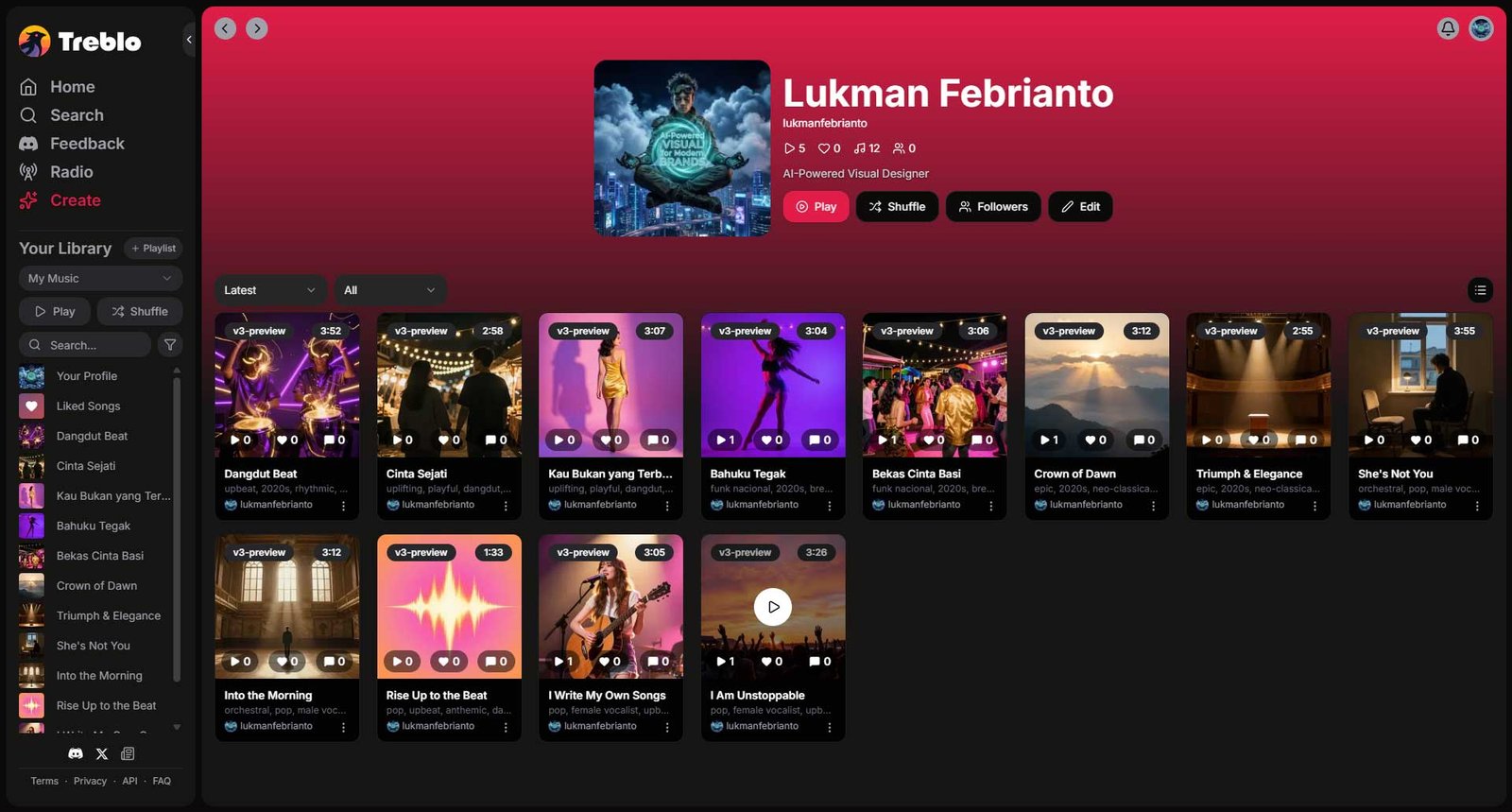
All 12 tracks from this test are published and playable on my Treblo profile — English Pop, Indonesian Dangdut, and Pop Orchestra, each tested across auto-generated lyrics, custom lyrics, and instrumental-only modes.
🎧 Listen to the full test catalog here: treblo.com/artist/lukmanfebrianto